100 days and Xeno’s Tortoise

Xeno’s Paradox lives!

It’s the old Greek tale that demonstrates it’s logically impossible to overtake a tortoise if you give it a head start. Because to catch up, you’ve got to travel halfway to him first. And when you get there, he’s a bit further ahead. You’ve now got to cover half the remaining distance. As you do, the tortoise plods a bit further. And so on.

Of course, it’s a fallacy. But it has some parallels to the writing process of 100 Days, 100 Grand.

In the middle of 2016, I spent three months solid on a big surge of content, with enough now there to start testing it as an actual work plan. (In other words, becoming a six-figure freelancer myself.) Did it work? Yes – and how. A single sales letter to a small list (fewer than 40 prospects!) led to a fully-booked September, with initial projects turning into new retainer clients at the rate of one a month. A situation still in progress now, six months later. (One reason I’m blogging on a Saturday afternoon.)

But of course, each new client took up days on the calendar…days I couldn’t spend on the book. In fact, September to December I completed barely one chapter a month. This has happened several times in the long slog to publication, and I expect it to happen again. It’s great for my own freelancing business, but no good for yours.

The book’s now 80% done: 235,000 words of 250,000 or so and 1096 pages of a planned 1200. (I know that’s not 80%, but I expect a great deal of current content to disappear in editing.) But each time I test a process, it reduces the amount of time I can spend on that last 20%. Pure Xeno’s Tortoise stuff. It’s both frustrating and exhilarating. Because I can see the finishing post… but my own actions are preventing me from reaching it.

“Win customers 10-20x faster than even pro marketers” – how?

book-cover2016! And here in London, it’s already making 2015 (a busy year) look like 2014.

A blatant plug first: my wife Lynne won our race to publish, and her brilliant cookbook Lynne’s Month of Meals is available from Amazon and bookstores, RRP £14.99. If you like exotic Indochinese food you can cook without being a whiz in the kitchen, take a look; she’s already sold enough copies to be in the top 1% of all indie authors. (Which puts a bit of pressure on me.)

But back to the blog. And a sentence that’s caused me some aggro. It’s in my home page blurbets:

  • Win customers 10-20x faster than even pro marketers!

I’ve had some blowback from pro marketers protesting it can’t be right. Pro marketers, by definition, get better results than random freelancers, surely?

Not always. To see why, let’s go where the pro marketers are.

Imagine you’re on an advertising agency’s direct marketing team, and your paying client wants a one-to-one marketing campaign.

Even for bigger agencies, DM is a bit like local radio: that distant cousin you don’t really spend much time with. (Odd that the most accountable medium of all is seen as more arcane than broadcast TV, but I don’t make the rules.) And client budgets tend to reflect this. For a fresh campaign, excluding production and postage, £20,000 would be high; figures like £5,000 are more common. And that money has to buy a copywriter, art director (yes, even plain letters need designing), print pro, and account handling expertise. For one DM letter there might be 7-8 people on the team.

Now, how much of their time does £5,000 buy?

Persuading an agency to spend just two weeks on your campaign’d be a stretch. Ten man-days, max. That’s not much time to understand your customer. Little chance to pinpoint that salient selling point that deserves A/B splitting. And definitely no list-building; they’ll have to buy it in.

Contrast that to the 100 Days approach. Where developing the perfect List and Letter to deliver your offer to the market is the main goal of three month’s work. A few distracted ad agency employees scrabbling around on deadline can’t compete.

And that’s why you can win more customers, much faster.

None of this disses old agency hands. Can you compete with a pro marketer… on a level playing field? No. But the field’s not level. In 100 Days, you’re spending three months working hard, following tried-and-tested rules, with the motivation that every penny of return accrues to you. That’s a resource that lets you understand what your market really is, hone your offer with precision, write from the heart so you’ll close the emotional sale first time. You have a far bigger “budget” to invest in yourself than most clients allow their agencies.

It’s why my campaigns for myself – like this DM letter – reach customer acquisition rates of nearly 20%. (100 Days aims for 1%.)

Which brings this blog full circle. Because to test the 100 Days methods, I’m doing another campaign for myself this month, the first in two years. Yes, I practice what I preach. There are countless marketing agencies out there, including thousands of good ones, but when it comes to marketing yourself your first option is you.


Afterword: working in from both ends

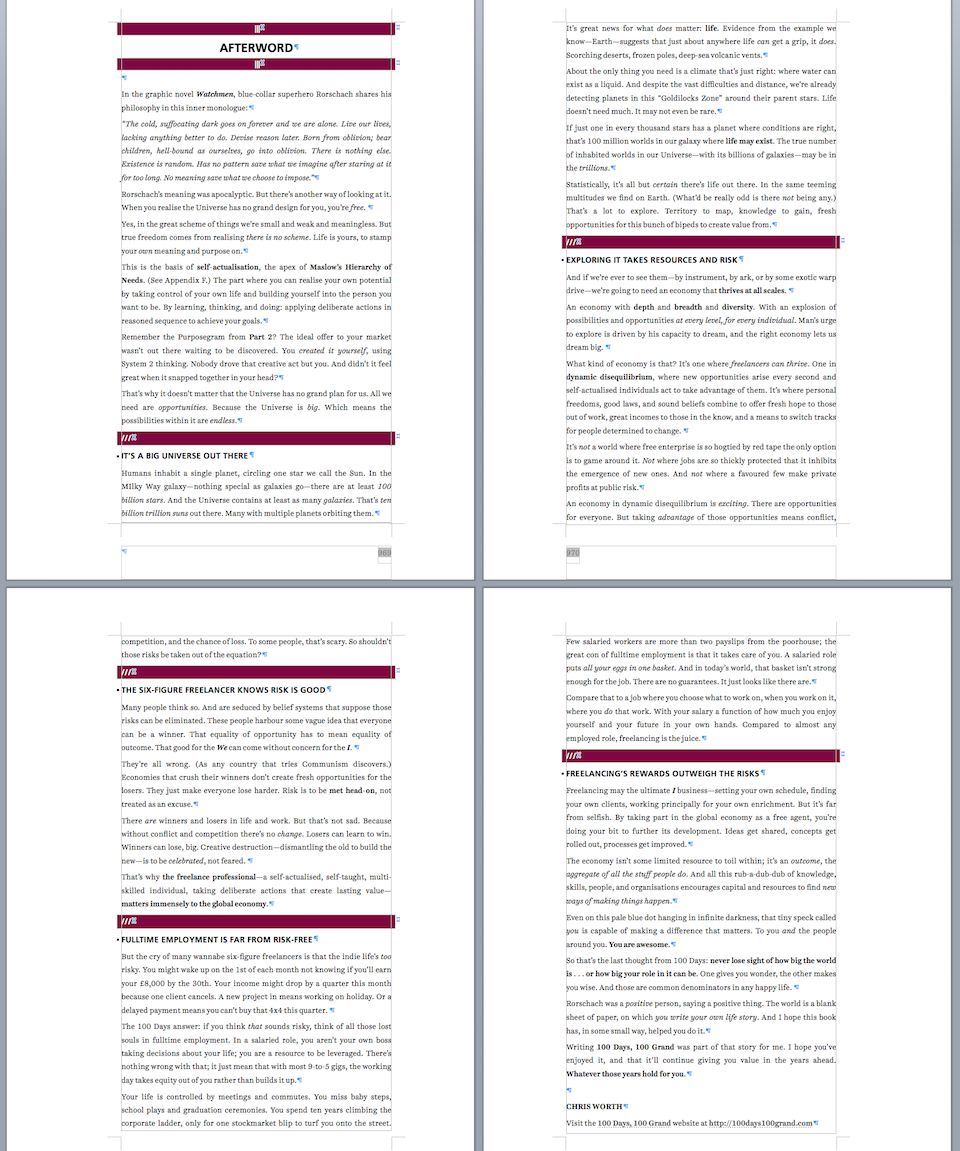
Both Parts 1 and 10 of the book are complete (I work from both ends inwards!) and among the flotsam and jetsam bookending the main text is this Afterword. I’m not sure quotes from graphic novels and musings on cosmology belong in a textbook for freelancers, but the self-actualised part certainly does. Don’t worry, it’ll all be edited down before the final cut.

The book's Afterword

Freelance framejack!

Chris Worth is an author and copywriter based in London.In tribute to the freelancer’s art, I habitually work in a T shirt, today a grey one I got as a gift from Australia. Symbolising my much-travelled life, my lower half is today clad in the trusty travel pants that have trekked over Saharan dunes and swum the Nile. As a declaration of how I live, far removed from the sheeplike commuting hordes of train and Tube, I did not shave this morning, and my hair is a little unkempt.
My personal style is a joyous celebration of the indie life: fiercely independent, proudly self-actualised, and accountable only to those I choose.

So, Mr Delivery Guy, your cheery “Sorry if I got you up” statement just now was a stab in the soul of truly monumental proportions.

Over 1,000 pages so far…

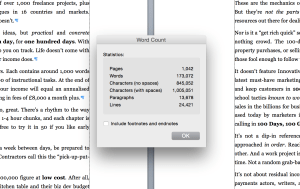
The four-digit barrier’s broken: as expected, the book so far runs to over 1,000 Letter-sized pages. That’s a lot.

Wordcount

While there’s still plenty to write – each day has content, but the last third of the work largely involves connecting the dots and improving the experience before a final month-long editfest late this year – I don’t expect the page count to increase much from here on in. Since each chapter is already planned out, with page and section breaks in place, and most of the content there in rough. It’s now a case of carpentry, not growing a forest.

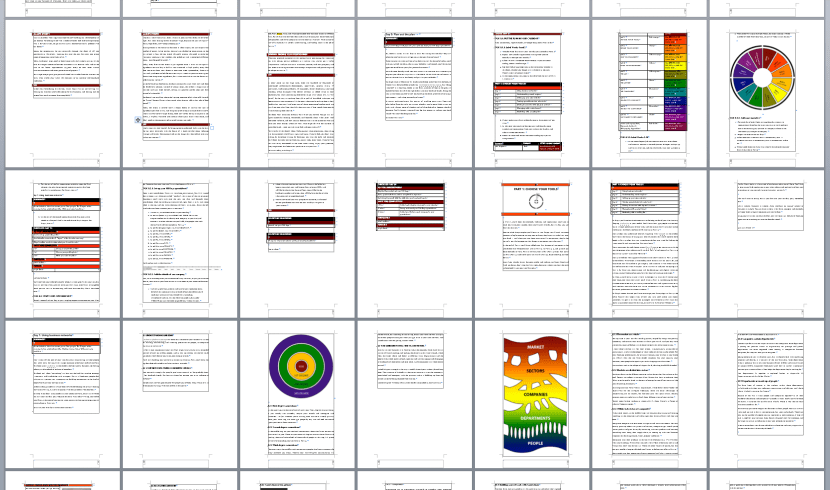
The pages you can see behind the popup, by the way, are on the web too: they’re the same text as What the book’s about. And yes, while I’d usually do a long piece in Scrivener or Snowflake, the linear nature of 100 Days, 100 Grand makes good ol’ Word the best choice for simply cutting and pasting all the bits together. (The book uses as source material a stack of notes and files I’ve used in my work going back over 15 years…)

Selection of pages from 100 Days, 100 Grand

A selection of pages from 100 Days, 100 Grand … with typesetting marks. Looking colourful!

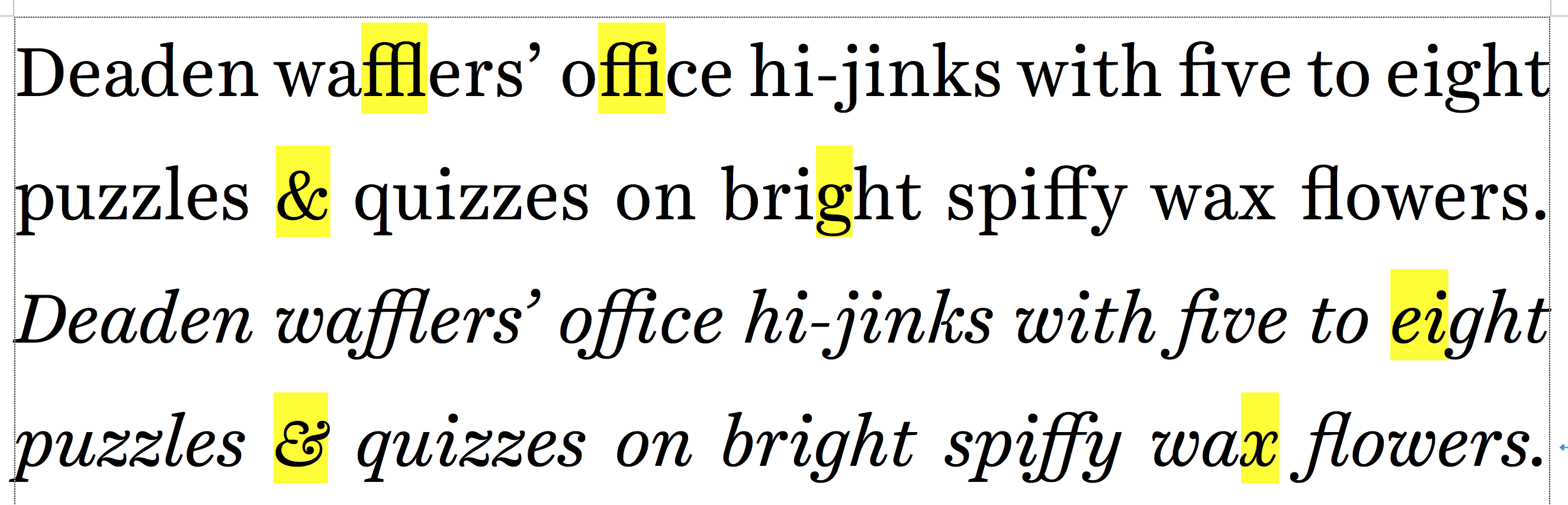
Typesetting will obviously move to InDesign (or, since I’m increasingly seduced by the beauty of whole-paragraph justification algorithms, LaTex). For the reason why, just look at the example paragraph and the table below it – comparison by Zink Typography.

Zink's comparison of Word, InDesign, and LaTex

Zink’s comparison of Word, InDesign, and LaTex

See how LaTex looks at the whole fruit? Instead of cramming as many words as possible on each line (the way Word does justification, which hasn’t changed since 2008), LaTex (pronounced lay-tek) averages out word spacing across an entire paragraph. Reducing the hyphenations (I have a hatred of hyphenating) and giving the block of text a far more consistent colour. Best of all, look at that SD. It means a much larger number of words in the paragraph have a similarly-sized space between them in LaTex.

LaTex is basically a bunch of macros for textmongering app Tex, which itself has an incredible pedigree – Tex’s creator, Donald Knuth, has a reasonable claim to be the greatest programmer of them all. I’m seeing whether I can apply LaTex style before the book goes to print.

Breakfast at the Shard

At the Shard building in London today, enjoying a glass of breakfast champagne with Mayor of London Boris Johnson.

Sad to say it was nothing to do with 100 Days, 100 Grand – my alma mater Warwick Business School was opening its London outpost (that’s the Dean and Vice Chancellor to the right of Boris) – but it was fun to pass on a caricature of the Mayor kicking down the door of No 10, drawn by my pal Simon Ellinas. (Who also cartooned at my wedding earlier this year!)

Screen Shot 2015-06-02 at 13.33.27


Third prelaunch email out today!

Weighty issues with publishingI’ve just dispatched the third email leading up to the book launch. Here’s a taste of its content: 12 precepts for your freelance business… or you can see the whole email here.

  1. Business is about making money. Money isn’t everything—but this book is about increasing your income, so money is its subject. If you’re not making money, you’re not in business.
  2. You earn money by delivering value. Money isn’t a goal, but a result. Value, when delivered to a business, helps that business become more successful. Value is what businesses pay for.
  3. You deliver value with your head and hands. The knowledge in your head turns into business value through your hands, whether you’re bashing on a keyboard or shaping steel in a skyscraper. All trades are manual trades, including rocket science and brain surgery.
  4. Your head and hands can be multiplied with tools. If you want holes in the ground, a digger is better than a shovel is better than a teaspoon. The right tools let you leverage your expertise and increase your capacity.
  5. The same multiplier applies to finding customers. Marketing is a numbers game; it’s easier to find one customer among 1,000 than 5. Focussed use of search engines, websites, and social networks can find large numbers of potential customers for reasonable effort.
  6. Customers exist in a world of abundance. Today’s tools open up your business offer to a vast network of customers. No market is small; no niche is narrow. In a global economy worth hundreds of trillions of dollars, there is a sizeable market for what you do, whatever it is.
  7. Dealing with abundance needs tight focus. The millions upon millions of people to work for out there range from square pegs to round ‘holes, from bottom-barrel to top-dollar. A broad market needs a narrow approach: your job is not to find customers, but to find the right
  8. Tight focus leads to repeat customers. The right customers are those for whom you deliver value over time. It’s six times harder to acquire a customer than retain one you’ve got. Customers who come back let you add greater value as you learn their needs, deepening your relationship.
  9. Repeat customers let you plan for the future. Consistent income from several customers lets you invest resources, grow your revenues, and develop practices and processes that save time. Repeat customers are the only customers that matter.
  10. Planning leads to good habits. Building a list of 1,000 customers is a big job if done all at once, but far easier if spread over 100 days. The right habits, applied over time, deliver big outcomes. And that comes from planning ahead.
  11. Good habits come from good data. Improvement isn’t a line but a loop. Only by looking at the outcomes of what you’ve done can you make the right decisions about what to do next. Over time, all those informed improvements have a great effect.
  12. Good data can be small data. When combined with your intuition, it doesn’t take much to tell you what worked and what went wrong. Look at the outliers and edge cases for clues, and use the insights to improve your practices. This is how your business makes money.