
Category: 100 days 100 grand
Solid publication date set
Setting a publication date is like doing exams: there’s no backing out, but knowing you have to aim for an exact date concentrates the mind. Accordingly, and with over 200,000 words in the can, I’ve set a concrete date to get the book into stores.
100 Days, 100 Grand will be available for purchase on Nov 30, 2017.
The completion pathway between now and then includes a long summer lock-in in a property I own … bracketed by a couple of courses I’ve wanted to take for years.

100 Days global HQ
The property you know: 100 Days HQ is a tricked-out garage in London, mostly used as a home gym although home’s now somewhere else. The courses are two fitness qualifications I’ve long wanted to try: the PCC and RKC instructor certifications in progressive calisthenics and kettlebells.
The first, in May, is followed by the lock-in; the second, in Nov, signals its close. (I’m not an instructor, but I do write a bit on fitness at Medium, and doing some professional development might help me know what I’m talking about.) That close means everything: text, typesetting, proofing, visuals, the lot, all ready to go to the distributor.
Of course, I’m taking my own medicine – everything planned for the next six months, with daily tasks and checklists just like 100 Days itself – and unless I’ve made serious miscalculations or get hit by a bus, it should go smoothly.
After all, writing a textbook is much like fitness. You can’t just jump on a bar and pump out 20 reps: you need to start small, progress smoothly, level up when you’re ready. And this summer stint should get me to the finish line.
Levelling up: Steven Low’s Overcoming Gravity
 Every field has its core textbook. Writing has the tiny Elements of Style; medicine has Gray’s Anatomy and Molecular Biology of the Cell. And I’m still partial to Eric Drexler’s Nanosystems from decades back.
So if you’re teasing a textbook into being, you feel an instant affinity with anyone who’s done the same. Someone who has is gymnastics instructor Steven Low, whose second edition of Overcoming Gravity has just hit the shelves.
I don’t know Low, but the first edition gained a reputation as the bible of bodyweight training. It’s also an indie effort: unlike the slickly typeset professionalism in the campus bookstore, it’s clearly the work of one man. The result is everything a textbook should be: expert knowledge, coherent structure, and practical advice plainly communicated, with actual numbers attached for your reps and sets. Enabling any able-bodied (or differently-abled) individual to train to a high level of ability without ever taking a gym class.
And that’s why I’m blogging about a gymnast’s training manual. Because it’s a textbook (!) case in taking your knowledge to the world in print.
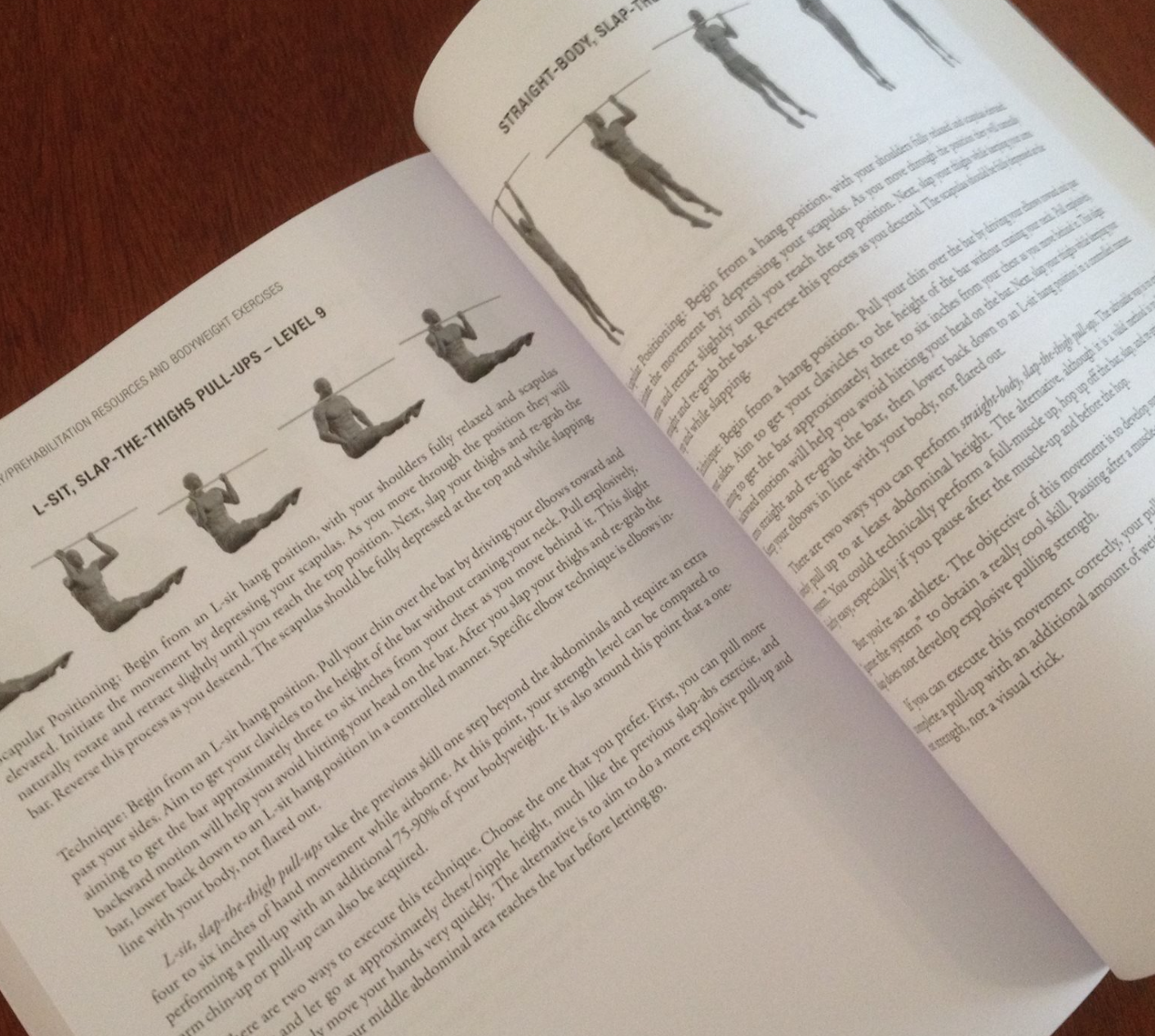 The B&W US-Letter sized 600-page softcover (you always note these things when you’re an indie) hits the table with about the same thump as 100 Days, 100 Grand – I’m planning 1200, but Low’s opus uses thicker stock. Each page is high-wordcount; one critique would be the narrowness of margins (the print version of 100 Days will have more scribble space) but that’s just me. The cover art is beautifully simple, a limited font choice and silhouettes of master moves like the iron cross and planche.
Like 100 Days, 100 Grand, it’s split into Parts, each a sequence of different activities building towards an end goal. Part 1 covers the fundamentals: principles of leverage, progressive resistance, the relationship between muscle and nerve – it’s where you start. Part 2 is the main course: the process of constructing a routine that works for you, what basic exercises to select and how to combine them in a workout plan. Part 3 goes into side factors like cross-training and injury management for anyone interested, while 5 sequences the actual exercises, Levels 1 to 16 in groups of four that mirror the ABCD difficulty ratings of gymnastics.
Of course, master moves like the one-arm planche illustrated on the cover aren’t among most people’s goals, but it’s great to see where the progression pathway that starts with sitting on your hands leads.
But you know what really matters here? The human stuff.
Much of the text is plain-spoken declarative sentences. But a sense of warmth floods from its pages. You somehow know how much work went into this, how many hours Low spent at his desk or in his gym writing, testing, checking, and writing again. It’s a celebration of personal achievement: the idea that with the right knowledge and practices, anyone can master their body.
And that’s what it has in common with 100 Days, 100 Grand: the empowerment of the individual. My goal is to make freelancing less of a crapshoot; Low’s is to show how anyone can achieve full control over their body. Whether you want a six-figure income or a six-pack abdomen, the basic thinking behind both books is the same.
100 days and Xeno’s Tortoise
Xeno’s Paradox lives!
It’s the old Greek tale that demonstrates it’s logically impossible to overtake a tortoise if you give it a head start. Because to catch up, you’ve got to travel halfway to him first. And when you get there, he’s a bit further ahead. You’ve now got to cover half the remaining distance. As you do, the tortoise plods a bit further. And so on.
Of course, it’s a fallacy. But it has some parallels to the writing process of 100 Days, 100 Grand.
In the middle of 2016, I spent three months solid on a big surge of content, with enough now there to start testing it as an actual work plan. (In other words, becoming a six-figure freelancer myself.) Did it work? Yes – and how. A single sales letter to a small list (fewer than 40 prospects!) led to a fully-booked September, with initial projects turning into new retainer clients at the rate of one a month. A situation still in progress now, six months later. (One reason I’m blogging on a Saturday afternoon.)
But of course, each new client took up days on the calendar…days I couldn’t spend on the book. In fact, September to December I completed barely one chapter a month. This has happened several times in the long slog to publication, and I expect it to happen again. It’s great for my own freelancing business, but no good for yours.
The book’s now 80% done: 235,000 words of 250,000 or so and 1096 pages of a planned 1200. (I know that’s not 80%, but I expect a great deal of current content to disappear in editing.) But each time I test a process, it reduces the amount of time I can spend on that last 20%. Pure Xeno’s Tortoise stuff. It’s both frustrating and exhilarating. Because I can see the finishing post… but my own actions are preventing me from reaching it.
That snap-to-grid feeling
Companies like Adobe, and other creative types like games designers, build a feature called “snap to grid” into their products. It’s useful when you’re moving an element around an area – like a line of text on a page layout, or a flooring tile in Fallout 4. When it gets close to a related element, it “snaps into place”. Relieving you of having to place it pixel-perfect.
 This month, the 100 Days, 100 Grand manuscript seems to be “snapping to grid”.
Without going into details, 2016 so far has been one long slog of making ideas, tasks, actions, and other bits of knowledge consistent with the overall flow of the 220,000-word text. In one session I deleted a 12,000-word section because it just didn’t fit properly. (If I didn’t do this, I’d end up with a book a bit like the car in Johnny Cash’s One Piece at a Time“. An end result that ought to work, but uses so many pieces from different sources it’s a pile of junk.)
Who’d be a textbook author?
This has caused me huge problems. Because 100 Days is so cross-connected, full of evolving actions and information dependencies, it’s more like designing a building than writing paragraphs. If I hadn’t realised last year that that its core message – celebrating individual self-actualisation – has become my life’s purpose, I’d even wonder whether to carry on.
(Naturally, testing the methods at Chris does Content has won me new business … income that pays my bills. Any income I might get from writing a 1200-page textbook is deferred for years. If 100 Days was just for fun, rather than a mission, it’d be much harder to schedule into my working week.)
Much of Spring was a logjam of trying to make Part 2 – where you define your offer to the market – work properly as a week of actionable instructions. It’s still far from complete. So this month, I switched to editing some Part 9 chapters, on turning your first billable projects into regular customers. And guess what? It snapped to grid.
Editing Day 85, I realised its content relied on some descriptors the reader creates earlier in Part 5. (Descriptors are information tags that describe a name on your marketing list, so you can personalise it more deeply with your sales letter. Personalisation is a huge part of how you win customers in 100 Days, 100 Grand.) Wahey! Text junked, text rewritten. The same thing’s happening today with Day 86 – and, looking ahead, with Day 87.
I was deeply unhappy with the text of over half the book’s pages, but now everything’s snapping to grid, it’s much clearer what’s out of shape. And the irony is that all this snapping is further defining what needs to happen way back in troublesome Part 2.
I didn’t need to spend a quarter of a year agonising over the seven chapters of Part 2. I just needed to write Part 9 first, to see what it needed to say.
But that’s textbook writing for you.
New prelaunch email sent
The latest prelaunch email is out! Read it on the web here. If you’re not on the list, don’t forget to sign up for the next one!
“Win customers 10-20x faster than even pro marketers” – how?
 2016! And here in London, it’s already making 2015 (a busy year) look like 2014.
A blatant plug first: my wife Lynne won our race to publish, and her brilliant cookbook Lynne’s Month of Meals is available from Amazon and bookstores, RRP £14.99. If you like exotic Indochinese food you can cook without being a whiz in the kitchen, take a look; she’s already sold enough copies to be in the top 1% of all indie authors. (Which puts a bit of pressure on me.)
But back to the blog. And a sentence that’s caused me some aggro. It’s in my home page blurbets:
- Win customers 10-20x faster than even pro marketers!
I’ve had some blowback from pro marketers protesting it can’t be right. Pro marketers, by definition, get better results than random freelancers, surely?
Not always. To see why, let’s go where the pro marketers are.
Imagine you’re on an advertising agency’s direct marketing team, and your paying client wants a one-to-one marketing campaign.
Even for bigger agencies, DM is a bit like local radio: that distant cousin you don’t really spend much time with. (Odd that the most accountable medium of all is seen as more arcane than broadcast TV, but I don’t make the rules.) And client budgets tend to reflect this. For a fresh campaign, excluding production and postage, £20,000 would be high; figures like £5,000 are more common. And that money has to buy a copywriter, art director (yes, even plain letters need designing), print pro, and account handling expertise. For one DM letter there might be 7-8 people on the team.
Now, how much of their time does £5,000 buy?
Persuading an agency to spend just two weeks on your campaign’d be a stretch. Ten man-days, max. That’s not much time to understand your customer. Little chance to pinpoint that salient selling point that deserves A/B splitting. And definitely no list-building; they’ll have to buy it in.
Contrast that to the 100 Days approach. Where developing the perfect List and Letter to deliver your offer to the market is the main goal of three month’s work. A few distracted ad agency employees scrabbling around on deadline can’t compete.
And that’s why you can win more customers, much faster.
None of this disses old agency hands. Can you compete with a pro marketer… on a level playing field? No. But the field’s not level. In 100 Days, you’re spending three months working hard, following tried-and-tested rules, with the motivation that every penny of return accrues to you. That’s a resource that lets you understand what your market really is, hone your offer with precision, write from the heart so you’ll close the emotional sale first time. You have a far bigger “budget” to invest in yourself than most clients allow their agencies.
It’s why my campaigns for myself – like this DM letter – reach customer acquisition rates of nearly 20%. (100 Days aims for 1%.)
Which brings this blog full circle. Because to test the 100 Days methods, I’m doing another campaign for myself this month, the first in two years. Yes, I practice what I preach. There are countless marketing agencies out there, including thousands of good ones, but when it comes to marketing yourself your first option is you.
Afterword: working in from both ends
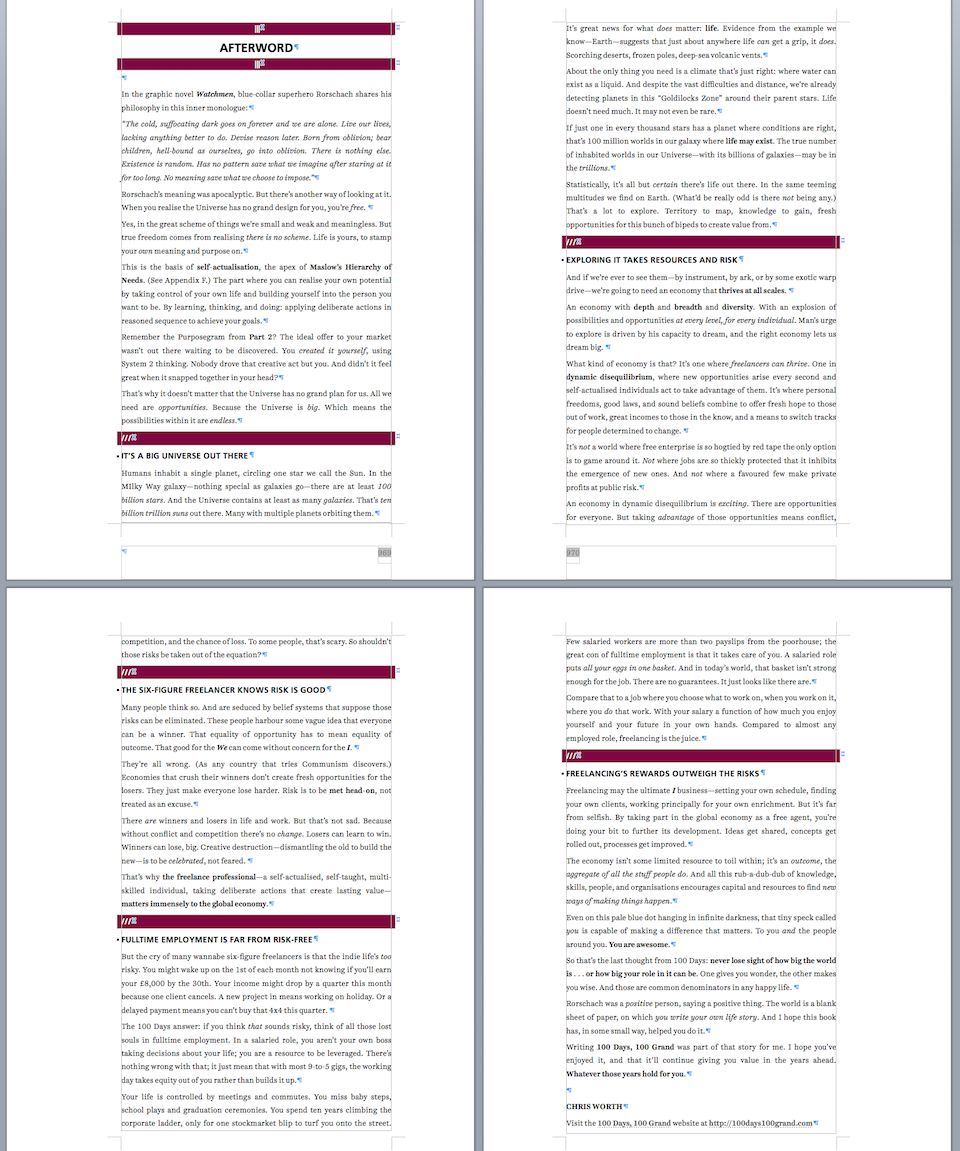
Both Parts 1 and 10 of the book are complete (I work from both ends inwards!) and among the flotsam and jetsam bookending the main text is this Afterword. I’m not sure quotes from graphic novels and musings on cosmology belong in a textbook for freelancers, but the self-actualised part certainly does. Don’t worry, it’ll all be edited down before the final cut.
Summer newsletter now out…
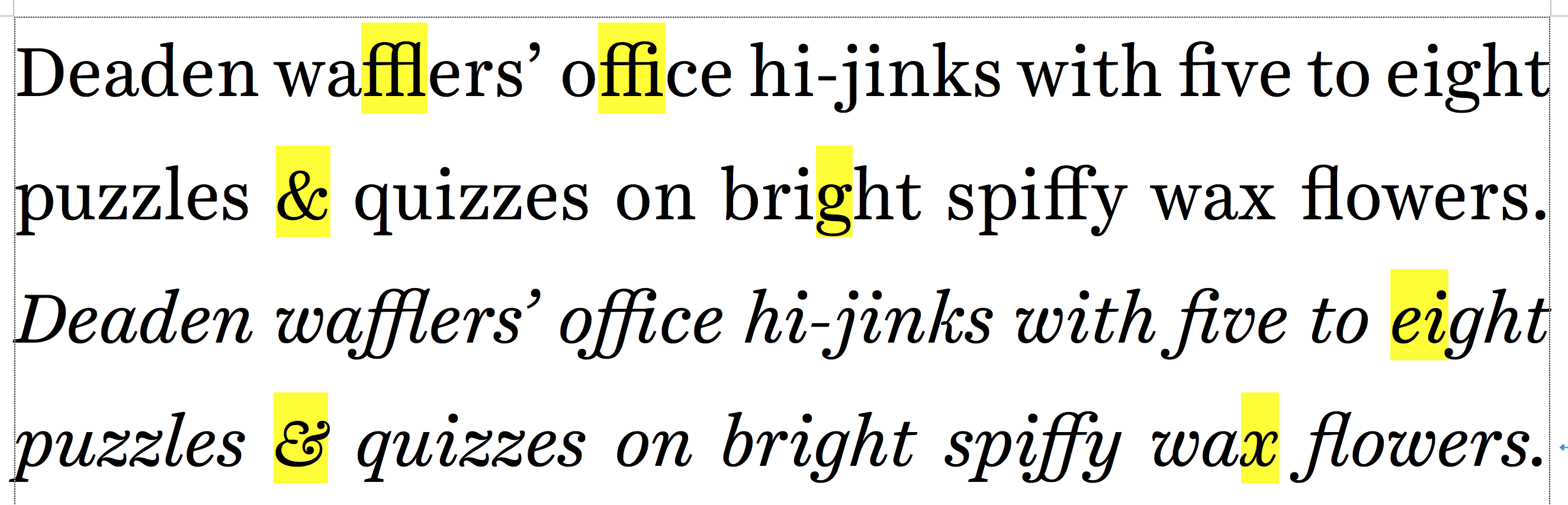
The latest update on 100 Days, 100 Grand has just gone out to its now hundreds-strong mailing list. Some explanation of what’s happening with the release date, in addition to some self-indulgent musings about typography…
… see the full text, or sign up for the list (no more than one email a month) if you haven’t already.
Over 1,000 pages so far…
The four-digit barrier’s broken: as expected, the book so far runs to over 1,000 Letter-sized pages. That’s a lot.
While there’s still plenty to write – each day has content, but the last third of the work largely involves connecting the dots and improving the experience before a final month-long editfest late this year – I don’t expect the page count to increase much from here on in. Since each chapter is already planned out, with page and section breaks in place, and most of the content there in rough. It’s now a case of carpentry, not growing a forest.
The pages you can see behind the popup, by the way, are on the web too: they’re the same text as What the book’s about. And yes, while I’d usually do a long piece in Scrivener or Snowflake, the linear nature of 100 Days, 100 Grand makes good ol’ Word the best choice for simply cutting and pasting all the bits together. (The book uses as source material a stack of notes and files I’ve used in my work going back over 15 years…)
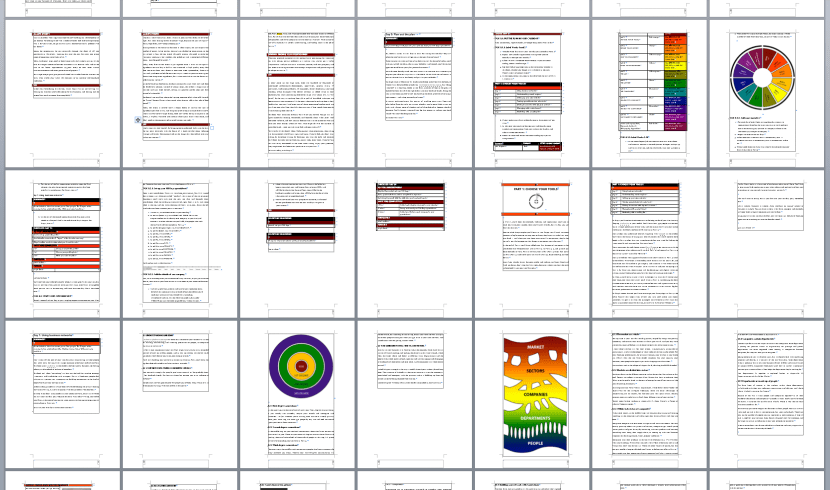
A selection of pages from 100 Days, 100 Grand … with typesetting marks. Looking colourful!
Typesetting will obviously move to InDesign (or, since I’m increasingly seduced by the beauty of whole-paragraph justification algorithms, LaTex). For the reason why, just look at the example paragraph and the table below it – comparison by Zink Typography.

Zink’s comparison of Word, InDesign, and LaTex
See how LaTex looks at the whole fruit? Instead of cramming as many words as possible on each line (the way Word does justification, which hasn’t changed since 2008), LaTex (pronounced lay-tek) averages out word spacing across an entire paragraph. Reducing the hyphenations (I have a hatred of hyphenating) and giving the block of text a far more consistent colour. Best of all, look at that SD. It means a much larger number of words in the paragraph have a similarly-sized space between them in LaTex.
LaTex is basically a bunch of macros for textmongering app Tex, which itself has an incredible pedigree – Tex’s creator, Donald Knuth, has a reasonable claim to be the greatest programmer of them all. I’m seeing whether I can apply LaTex style before the book goes to print.
Breakfast at the Shard
At the Shard building in London today, enjoying a glass of breakfast champagne with Mayor of London Boris Johnson.
Sad to say it was nothing to do with 100 Days, 100 Grand – my alma mater Warwick Business School was opening its London outpost (that’s the Dean and Vice Chancellor to the right of Boris) – but it was fun to pass on a caricature of the Mayor kicking down the door of No 10, drawn by my pal Simon Ellinas. (Who also cartooned at my wedding earlier this year!)

 100 DAYS, 100 GRAND - be earning six figures as a freelancer... 100 days from today!