
Category: book
I love to go a-rendering
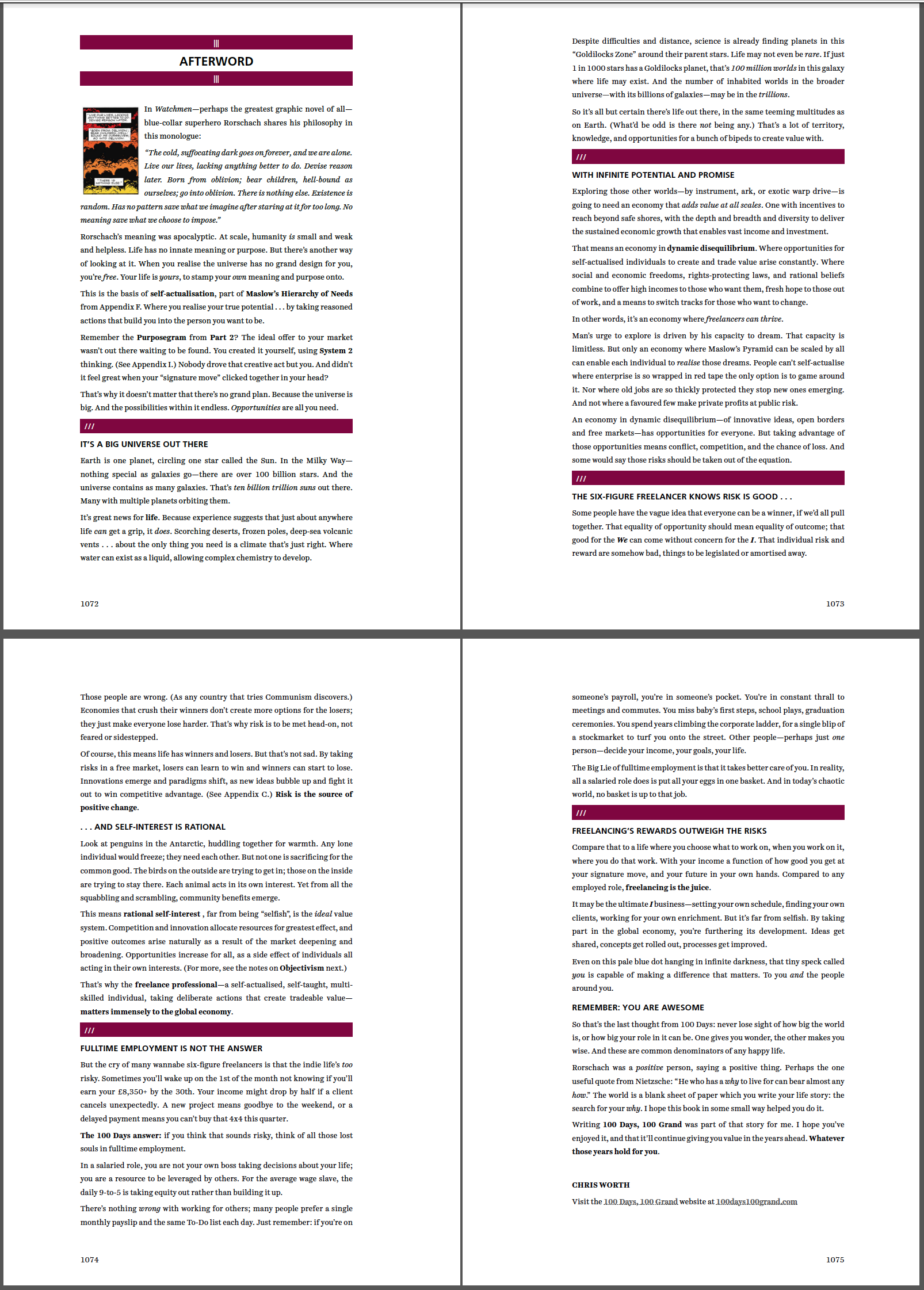
It’s only a mockup, but this is basically what the print book will look like (perfect-bound A4 paperback.) Getting closer…

Getting wordy on the Afterword
A four-page Afterword, in which I somehow manage to compare and contrast graphic novels, exploring the universe, employment’s effect on the family, and penguins! Might need a little editing…
Solid publication date set
Setting a publication date is like doing exams: there’s no backing out, but knowing you have to aim for an exact date concentrates the mind. Accordingly, and with over 200,000 words in the can, I’ve set a concrete date to get the book into stores.
100 Days, 100 Grand will be available for purchase on Nov 30, 2017.
The completion pathway between now and then includes a long summer lock-in in a property I own … bracketed by a couple of courses I’ve wanted to take for years.

100 Days global HQ
The property you know: 100 Days HQ is a tricked-out garage in London, mostly used as a home gym although home’s now somewhere else. The courses are two fitness qualifications I’ve long wanted to try: the PCC and RKC instructor certifications in progressive calisthenics and kettlebells.
The first, in May, is followed by the lock-in; the second, in Nov, signals its close. (I’m not an instructor, but I do write a bit on fitness at Medium, and doing some professional development might help me know what I’m talking about.) That close means everything: text, typesetting, proofing, visuals, the lot, all ready to go to the distributor.
Of course, I’m taking my own medicine – everything planned for the next six months, with daily tasks and checklists just like 100 Days itself – and unless I’ve made serious miscalculations or get hit by a bus, it should go smoothly.
After all, writing a textbook is much like fitness. You can’t just jump on a bar and pump out 20 reps: you need to start small, progress smoothly, level up when you’re ready. And this summer stint should get me to the finish line.
Levelling up: Steven Low’s Overcoming Gravity
 Every field has its core textbook. Writing has the tiny Elements of Style; medicine has Gray’s Anatomy and Molecular Biology of the Cell. And I’m still partial to Eric Drexler’s Nanosystems from decades back.
So if you’re teasing a textbook into being, you feel an instant affinity with anyone who’s done the same. Someone who has is gymnastics instructor Steven Low, whose second edition of Overcoming Gravity has just hit the shelves.
I don’t know Low, but the first edition gained a reputation as the bible of bodyweight training. It’s also an indie effort: unlike the slickly typeset professionalism in the campus bookstore, it’s clearly the work of one man. The result is everything a textbook should be: expert knowledge, coherent structure, and practical advice plainly communicated, with actual numbers attached for your reps and sets. Enabling any able-bodied (or differently-abled) individual to train to a high level of ability without ever taking a gym class.
And that’s why I’m blogging about a gymnast’s training manual. Because it’s a textbook (!) case in taking your knowledge to the world in print.
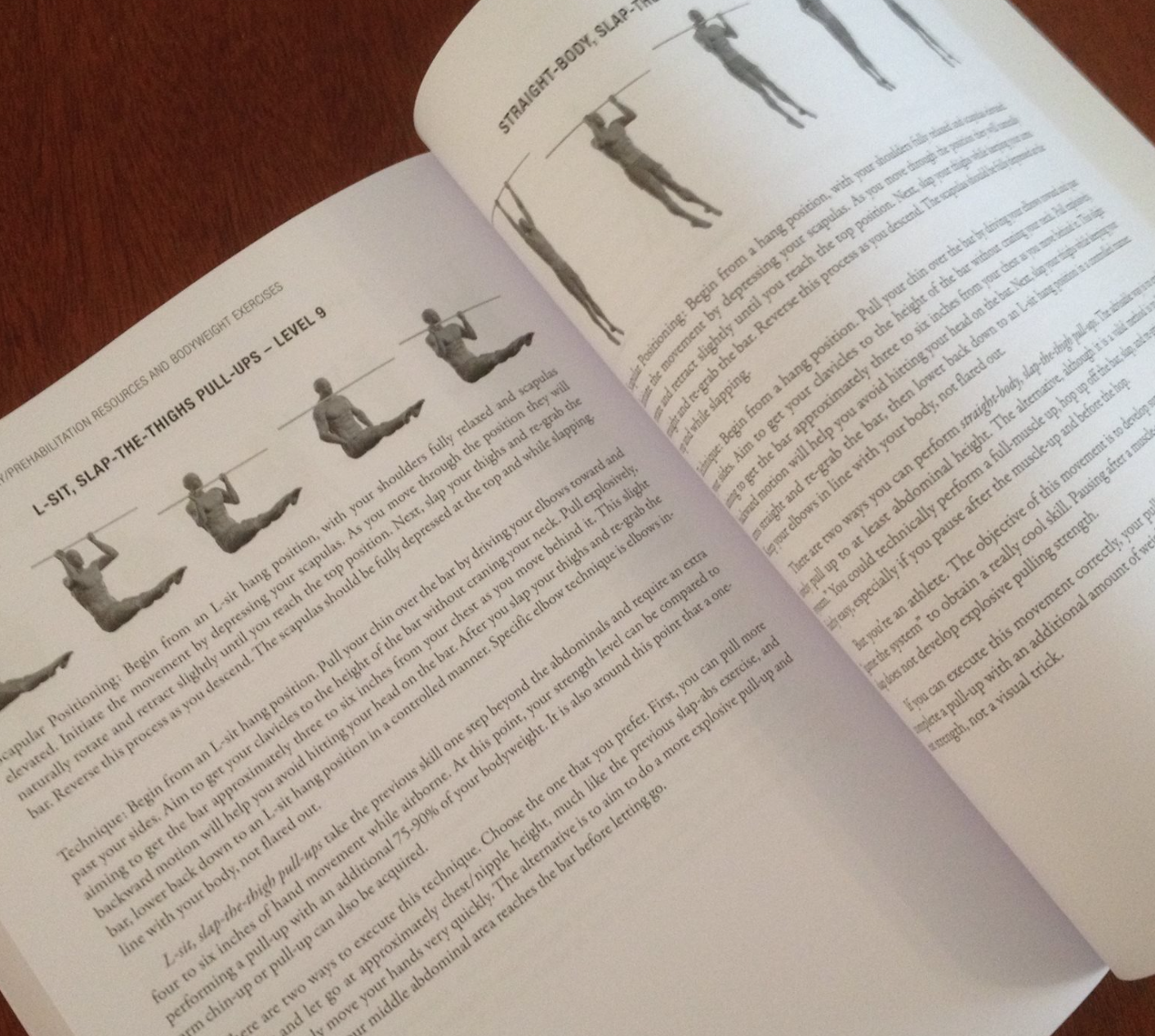 The B&W US-Letter sized 600-page softcover (you always note these things when you’re an indie) hits the table with about the same thump as 100 Days, 100 Grand – I’m planning 1200, but Low’s opus uses thicker stock. Each page is high-wordcount; one critique would be the narrowness of margins (the print version of 100 Days will have more scribble space) but that’s just me. The cover art is beautifully simple, a limited font choice and silhouettes of master moves like the iron cross and planche.
Like 100 Days, 100 Grand, it’s split into Parts, each a sequence of different activities building towards an end goal. Part 1 covers the fundamentals: principles of leverage, progressive resistance, the relationship between muscle and nerve – it’s where you start. Part 2 is the main course: the process of constructing a routine that works for you, what basic exercises to select and how to combine them in a workout plan. Part 3 goes into side factors like cross-training and injury management for anyone interested, while 5 sequences the actual exercises, Levels 1 to 16 in groups of four that mirror the ABCD difficulty ratings of gymnastics.
Of course, master moves like the one-arm planche illustrated on the cover aren’t among most people’s goals, but it’s great to see where the progression pathway that starts with sitting on your hands leads.
But you know what really matters here? The human stuff.
Much of the text is plain-spoken declarative sentences. But a sense of warmth floods from its pages. You somehow know how much work went into this, how many hours Low spent at his desk or in his gym writing, testing, checking, and writing again. It’s a celebration of personal achievement: the idea that with the right knowledge and practices, anyone can master their body.
And that’s what it has in common with 100 Days, 100 Grand: the empowerment of the individual. My goal is to make freelancing less of a crapshoot; Low’s is to show how anyone can achieve full control over their body. Whether you want a six-figure income or a six-pack abdomen, the basic thinking behind both books is the same.
New prelaunch email sent
The latest prelaunch email is out! Read it on the web here. If you’re not on the list, don’t forget to sign up for the next one!
Afterword: working in from both ends
Both Parts 1 and 10 of the book are complete (I work from both ends inwards!) and among the flotsam and jetsam bookending the main text is this Afterword. I’m not sure quotes from graphic novels and musings on cosmology belong in a textbook for freelancers, but the self-actualised part certainly does. Don’t worry, it’ll all be edited down before the final cut.
Over 1,000 pages so far…
The four-digit barrier’s broken: as expected, the book so far runs to over 1,000 Letter-sized pages. That’s a lot.
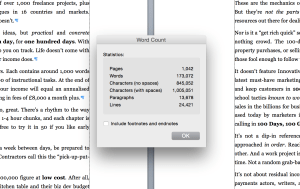
While there’s still plenty to write – each day has content, but the last third of the work largely involves connecting the dots and improving the experience before a final month-long editfest late this year – I don’t expect the page count to increase much from here on in. Since each chapter is already planned out, with page and section breaks in place, and most of the content there in rough. It’s now a case of carpentry, not growing a forest.
The pages you can see behind the popup, by the way, are on the web too: they’re the same text as What the book’s about. And yes, while I’d usually do a long piece in Scrivener or Snowflake, the linear nature of 100 Days, 100 Grand makes good ol’ Word the best choice for simply cutting and pasting all the bits together. (The book uses as source material a stack of notes and files I’ve used in my work going back over 15 years…)
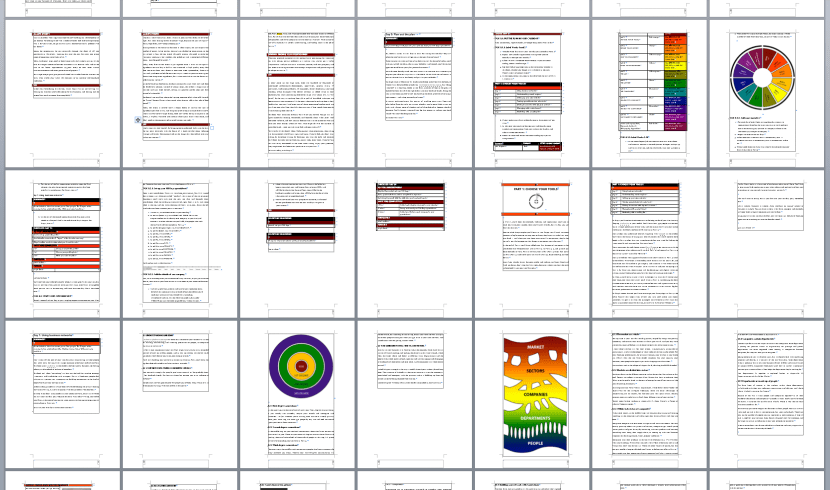
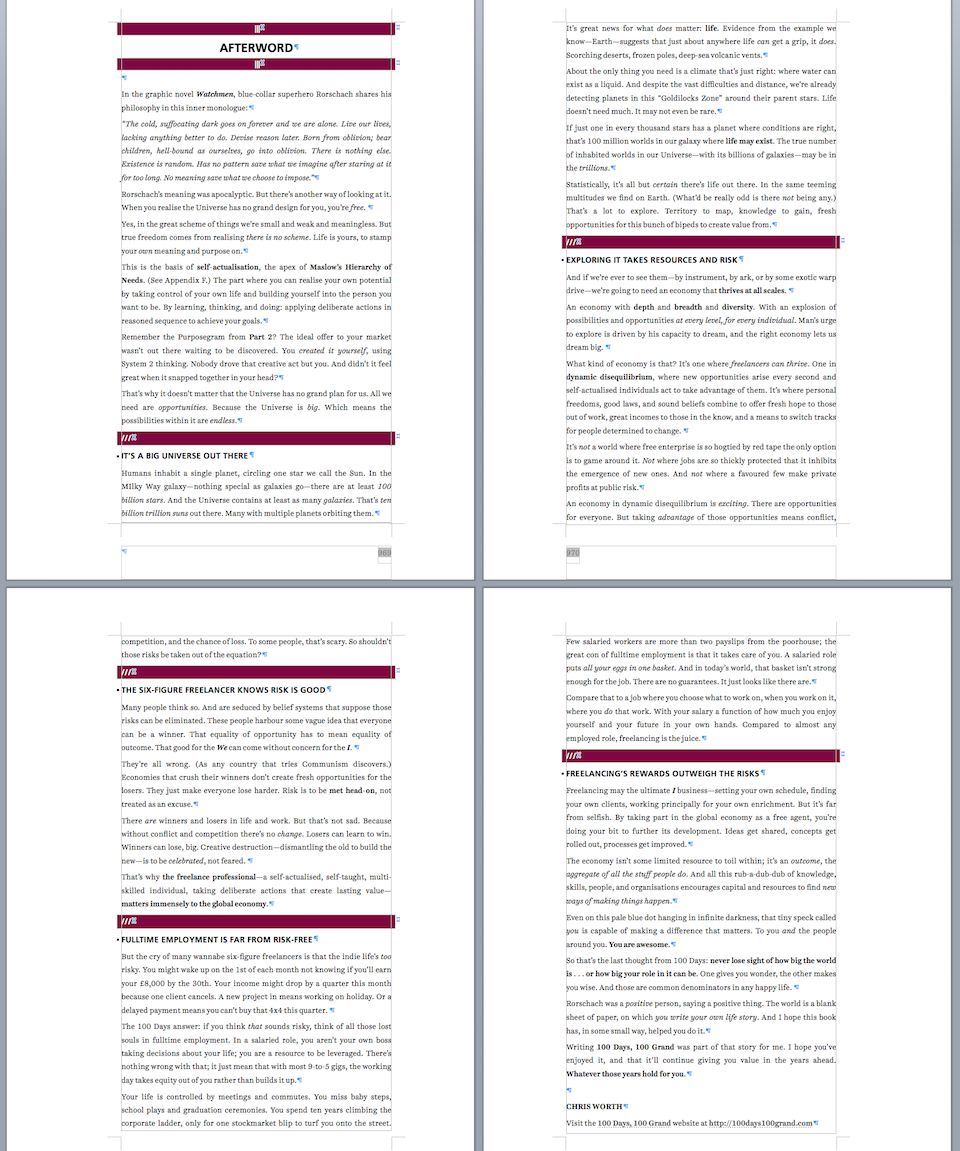
A selection of pages from 100 Days, 100 Grand … with typesetting marks. Looking colourful!
Typesetting will obviously move to InDesign (or, since I’m increasingly seduced by the beauty of whole-paragraph justification algorithms, LaTex). For the reason why, just look at the example paragraph and the table below it – comparison by Zink Typography.

Zink’s comparison of Word, InDesign, and LaTex
See how LaTex looks at the whole fruit? Instead of cramming as many words as possible on each line (the way Word does justification, which hasn’t changed since 2008), LaTex (pronounced lay-tek) averages out word spacing across an entire paragraph. Reducing the hyphenations (I have a hatred of hyphenating) and giving the block of text a far more consistent colour. Best of all, look at that SD. It means a much larger number of words in the paragraph have a similarly-sized space between them in LaTex.
LaTex is basically a bunch of macros for textmongering app Tex, which itself has an incredible pedigree – Tex’s creator, Donald Knuth, has a reasonable claim to be the greatest programmer of them all. I’m seeing whether I can apply LaTex style before the book goes to print.
Readership into five figures for new LinkedIn article
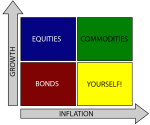 It’s not news if that’s how you found this site, but an article I wrote for LinkedIn’s Pulse is among the most-viewed articles on the business networking site this week, with over 25,000 views in its first 48 hours…
100 Days, 100 Grand and System 1, System 2
It’s time to get psyched.
 The Tasks in 100 Days, 100 Grand are simple actions in logical sequence, most involving spreadsheets, documents, and websites. But even if you’re expert with Excel and Word, you’ll find your brain turning backflips at times—and wonder why.
The reason involves something called System 1 and System 2. The terms (shortened to S1 and S2) were coined by psychologist Daniel Kahneman to denote the main ways humans respond to information. Each can be summed up in a paragraph, and they’re the only bits of proper psychology in the book. (After all, psychology is a complex subject, and an instructional text on freelancing isn’t the forum for explaining it even if I had the training.) But a basic outline of the idea gives you a useful model for understanding customer motivations. Call System 1 the feeling system and System 2 the thinking system.
System 1 is what governs most people’s behaviour, most of the time. It’s your animal instincts and emotional responses, evolved over millions of years, most spent trolling the African grasslands in fear and hunger. That sudden rush of adrenalin urging you towards fight or flight, that rush of anger when you see someone threatened, that irrational fear of boarding the plane because you saw a crash on the news yesterday—all these reactions are from your System 1.
S1 thrives today because for most creatures, reacting without thinking is a useful skill. (You don’t want to think for too long when your food chain’s apex predator is looking at you as if you’re labelled LUNCH.) System 1 attaches great importance to what’s here and now, right in front of your nose. It’s subjective, driving you to do what feels right at the time.
If System 1 shows your animal side, System 2 is arguably what makes you human. It’s your ability to think critically and reason logically. It’s how a bunch of bipeds in Africa started wearing clothes, making tools, and building communities. System 2 lets you plan ahead, assessing information with a cool head and making decisions that deliver expected outcomes.
System 2 is harder to use than System 1. Because it asks you to stop and understand stuff, grasp concepts and engage in abstract thought. That’s why you’ll find parts of 100 Days, 100 Grand hard work, even if you find the individual Tasks simple. Every chapter makes you think and reach decisions using S2, not S1. System 2 is objective, forcing you to analyse situations and make considered responses.
(System 2 is the reason 100 Days uses a lot of checklists. Checklists force you to put your thinking head on, and make decisions rationally and logically.)
If there’s one difference between 100 Days and a self-help book, it’s that 100 Days forces you to use your System 2, not the feel-good of your System 1. Although eliciting reactions from other people’s System 1 is one of the bigger tasks you’ll check off along the way. Because there’s another term for “eliciting reactions from System 1”. It’s known as Marketing.
Why the halfway mark is more than halfway
 November’s been a good month for 100 Days. (Not least because it’s been a slow month for my other work.) Huge improvements, but the big news is the main text is now hitting 100,000 words… which means I’ve found the edges of the jigsaw.
Why that matters:
In any large project – from a thriller novel to a house build – a big part of progress is “finding the edges”. Recognising where the parameters of the job stop and start. And for most of the last four months I was trying to define them.
The basic ten-part, fourteen-week structure of the book’s been clear since I started writing in July. But the fine detail within it – what the reader does each day, and how those actions slot together in sequence to deliver the broader objective of a £100,000 income – was much harder. Now, after many sleepless nights of blood, sweat, and toil, I believe my jumbled mass of actions and outcomes (over 400 pages of scribbled ideas) is starting to become an orderly series of information and instructions a non-marketer will find useful. And completed chapters are starting to fly out.
Originally I thought 100 Days would be a tract of 40-60,000 words. (After all, it started as just a blog post and Buzzfeed listicle outlining the idea!) As it turns out, there are two sub-audiences: the techie who knows the tools, and the freelancer who’s expert in his own field but not necessarily at marketing himself. The best way to cater for both is to separate informational (concepts) and instructional (methods and tasks) content. So each chapter now starts with a set of information and ends with a list of tasks that put them to use, coming together in a “Do you understand/have you completed” checklist. (Savvy marketers only need the methods; other experts will do the daily Tasks.)
This means an increase in wordcount, and the total’s now likely to break 200,000 words and 1,000 pages. A side effect is that I’ve changed the publishing format: the paperback edition will be US Letter-sized, 21.59 x 27.94 cm, so people have plenty of room to scribble their notes in the margins.
(The ebook editions, as a happy byproduct, now look a lot better! With full-width tables and diagrams and better formatted text and lists. I’m testing the e-version on both an ancient Kindle Keyboard and a swoopy new Voyage and it looks great.)
The mailing list is growing, although there aren’t any updates yet; I’ll be sending out sneak peeks at chapters and diagrams as they harden. Head down again – see you next month!
 100 DAYS, 100 GRAND - be earning six figures as a freelancer... 100 days from today!